Events

Discussing potential, challenges and entry points for an agroecological transformation of food systems

Upcoming Events

COP30_AE_NMA_SoME_Card
COP30 UNFCCC side event : Agroecology as a non-market climate solution under Art. 6.8
12.11.2025
Side Event Room 8, Belém, Brazil

This session explores agroecology as an approach to implement non-(carbon) market approaches under Article 6.8 that help countries in delivering ambitious climate action – notably through NDCs and NAPs. Building on practical evidence from IP/LCs, farmers and civil society as well as country policy examples, the event will highlight key elements of agroecology that are at the core of NMAs such as cooperation, capacity-building of food system actors, holistic and integrated approaches, while minimizing environmental and social impacts. 

SoMe_Card_Adaptation_Finance_Event
Mobilizing Finance to Deliver on Global Goal on Adaptation: Pathways and Partnerships for resilient food systems
18.11.2025
Side Event Room 9, Belém, Brazil

Achieving the Global Goal on Adaptation (GGA) demands adequate and trackable financing for country-led adaptation solutions, yet this finance remains scarce, fragmented, and difficult to monitor, especially for vital climate-resilient food systems. This side event is designed to move beyond principles and identify practical approaches for unlocking adaptation finance.


CGIAR Pavilion Event Card
COP30 CGIAR Food & Agriculture Pavilion : Enabling holistic NDCs: Tools for integrated climate, biodiversity, and food system action
20.11.2025
COP30, Belém, Brazil

This event will explore practical tools and approaches that support countries throughout the NDC journey—from design to implementation, financing, and tracking—while fostering synergies between the Rio Conventions and other national objectives. Government representatives will open the session by reflecting on national needs for integrated, finance-ready climate action. Experts will then showcase tools and approaches addressing food systems, biodiversity, and climate priorities to support policymakers in translating commitments into measurable action, drawing on concrete examples from animal welfare and biopesticide innovations. 


Past Events

Screenshot 2025-10-17 at 12.06.47
Bridging the Gaps : Food & Agriculture Pre-COP30 strategy & solutions convening
07.11.2025
Santos, Brazil

Food systems sit at the heart of the climate change crisis. They are a primary source of greenhouse gas emissions but also hold powerful pathways to adaptation, resilience, restoration and justice. Misaligned policies and fragmented approaches have deepened the crisis, but transforming food and agricultural systems offers a unique opportunity to deliver for climate, nature and people.


Linkedin - SoMe card - SBSTTA27 Strategy to Implementation
From Strategy to Implementation — Cultivating Soil Biodiversity by Integrating Agroecology in NBSAPs and National Food System Policies
23.10.2025
Plenary Hall, Atlapa Convention Center, Panama City

Conservation and restoration of soil biodiversity is a critical, yet often overlooked, dimension of ecosystem health and resilience. This event builds on previous dialogues at SBSTTA25, SBSTTA26 and COP16, highlighting how food systems thinking and agroecology can provide transformative pathways for soil health and biodiversity. As countries move toward the implementation of their NBSAPs—and increasingly seek synergies with other Multilateral Environmental Agreements such as the UNFCCC and the Basel, Rotterdam and Stockholm Conventions—the discussion will focus on the enabling conditions that allow such transitions to be scaled, including planning tools, policy processes, and resource mobilization. 


Screenshot 2025-10-21 at 14.21.10
CFS 53 Side Event : Agroecology as a transformative pathway towards sustainable food systems: Scaling investments, policies and practices
23.10.2025
FAO, Green room and online

This side event examines the opportunities and dynamics of accelerating food systems transformation through agroecology. It outlines key imperatives and showcases promising initiatives related to enabling policies and platforms, innovative finance mechanisms and agroecology practices on the ground.   


Flyer_AE NbS in Action
Agroecological NbS in Action: Jointly Addressing the Resilience of Water, Soil, Biodiversity and People
10.10.2025 – 11:00-12:30 (UTC+4)
IUCN World Conservation Congress side event

This session explores agroecological approaches as cornerstones of agricultural NbS, highlighting how they sustain and bridge livelihoods, biodiversity, soil health and water resilience.

Event_visual_IUCN_WCC_Mainstreaming_FS_Tools_Presentation
Mainstreaming Food Systems in Biodiversity and Climate Agendas: Aligning National Commitments with Powerful Tools
10.10.2025 – 16:30-18:30 (UTC+4)
IUCN World Conservation Congress – Toolbox event

As countries develop, update, and implement their National Biodiversity Strategies and Action Plans (NBSAPs) and Nationally Determined Contributions (NDCs) to meet global and national biodiversity targets, integrating food systems presents a critical opportunity for transformative change that simultaneously advances biodiversity conservation and climate action.

Infopool_Visual_WFF YA session - Agrifood systems within NBSAPs
Youth Assembly consultation session: Agrifood systems within National Biodiversity Strategies and Action Plans (NBSAPs)
29.09.2025
Online

As the world moves toward implementing the Kunming-Montreal Global Biodiversity Framework (KMGBF), agri-food systems are emerging as a critical frontier for biodiversity conservation and restoration. This session brought together youth networks, UN institutions, and national representatives to explore how young people can influence the integration of agri-food systems into updated National Biodiversity Strategies and Action Plans (NBSAPs). Through technical insights, and interactive reflections, the session aimed to equip youth with the knowledge and agency to contribute meaningfully to biodiversity planning and governance.

Infopool_AFSF_event_20250903
Regenerating Africa: How Young Agripreneurs are Leading Food Systems Transformation through Agroecology for People and Planet
03.09.2025
AFSF, Dakar

Regenerating Africa: How are young agripreneurs are leading food systems transformation through agroecology for people and planet? This thematic session will highlight the role of African youth agripreneurs in advancing agroecology as a transformative pathway for sustainable food systems. Through an interactive dialogue format, real-world case studies, and cross-sectoral engagement, the session will demonstrate how agroecological principles—diversification, soil regeneration, circular economies, and local governance—are being put into action by young innovators. It will also unpack the enabling conditions needed—such as policy alignment, access to finance, and knowledge networks—to mainstream youth-led agroecological solutions across the continent.

Infopool_20250723_Event_visual_UNFSS-Side-Event_From-Aspiration-to-Action_2707_14.00
From Aspiration to Action: Country Experiences on Mainstreaming Agroecology as Food System Transformation Pathway
27 July 2025, 14:00–15:15 EAT
UNFSS+4 side event, Addis Ababa, Ethiopia

This event will showcase how governments and non-state actors are leveraging agroecology for sustainable food systems by embedding agroecological priorities into broader national frameworks (e.g. food system transformation pathways, climate strategies, nutrition actions) to ensure policy coherence, unlock investment, and align with global sustainability goals. It will showcase country experiences and will include sharing session in terms of how countries are addressing challenges to implementation including financing, science-policy-society interface and stakeholder engagement.

Infopool_Event card_SB62_Article 6.8
Agroecology as a Non-Market Approach – A Pathway for Climate Action and Sustainable Food Systems​
16.06.2025 – 16:30 CEST
Bonn Climate Change Conference SB62 – Bonn room

This session explored how agroecology aligns with non-market approaches (NMAs) under Article 6.8 of the Paris Agreement. Panelists discussed key NMA principles and pathways for integrating agroecology into climate action and sustainable food systems beyond carbon markets. 

Infopool_BRS COP 2025 Side Event Flyer
Accelerating the transition from HHPs to biopesticides and agroecological alternatives
02.05.2025 – 18:15 CEST
Geneva International Conference Center, room 14 and online

This hybrid side event to the COPs of the Basel, Rotterdam and Stockholm (BRS) Conventions explored the impacts of Highly Hazardous Pesticides (HHPs) on environmental and public health and pathways to advancing biopesticide initiatives and agroecology-based solutions. It also discussed the benefits, adoption challenges, and policy options for scaling up biopesticides and implementing agroecological approaches with a focus on chlorpyrifos. 

Infopool_AEC_Flyer-webinar-18-Feb-25
Agroecology and the COPs: Insights from 2024 and the way to Belém
18.02.2025, 15:00-16:00 (CET)
Online, Zoom
In fall 2024, three Conferences of Parties (COP) took place on biodiversity, climate, and desertification. As 2025 starts, all attention is focused on COP 30 on climate in Belem, Brazil. The webinar is co-organized by the Agroecology Coalition and the Global Alliance for the Future of Food and it will tackle the following questions:
  • What were the progress made for food systems in the 2024 COPs? Where was agroecology positioned in these debates?
  • How can we leverage agroecology as an approach to break the silos of the 3 Rio conventions in 2025?
  • In view of COP 30 in Brazil, what would be a successful outcome for agroecology and food system transformation?
Infopool_Event__UNCCD_20241205
Bridging the three ​Rio Conventions​ through agroecology
05.12.2024, 11:00 – 12:30 (AST GMT+3)
UNCCD COP16, Riyadh (Saudi Arabia)

Food system transformation and land restoration are key to harmonizing action between the Rio conventions to achieve climate, biodiversity and land targets. This session discussed and featured how agroecology can connect and deliver on these agendas through various studies and practice on the ground.

Infopool_Event_Land-Agroecology_Reception_UNCCD_12-4-1
Land and Agroecology, Uniting Policy, Practice and Science​
04.12.2024, 19:00 – 21:00 (AST GMT+3)
UNCCD COP16, Riyadh (Saudi Arabia)

Hosted by BMZ/GIZ in cooperation with the Agroecology Coalition, Biovision Foundation, this evening reception hosted experts and organisations from the land use, agroecology, agriculture and food systems, forestry and biodiversity communities to discuss the interlinking of land and agroecology in achieving the objective of Land Degradation Neutrality.

Infopool_Visual_COP29_Innovative_NDCs_20241121
COP29 side event: Innovative NDCs 3.0 for food systems – Boosting ambition through water, agroecology, fisheries, and healthy diets
21.11.2024
COP29 UNFCCC, FAO-CIAR Pavilion Baku (Azerbaijan)

With the next revision of NDCs due by 2025, countries have to leverage key opportunities within food systems. Hence, this event highlighted the potential of agroecology, water systems, sector-specific initiatives in fisheries and healthy diets for ambitious national climate action. 

Infopool_COP29_Visual_event_20.11
COP29 side event: Investing in Biodiversity to improve nutritional and climate outcomes
20.11.2024
COP29 UNFCCC, Action on Food Hub, Baku (Azerbaijan)

This event will brought together faith, anti-hunger advocacy, policy analysis and investment experts, frontline food system transformation leaders, and horticultural research groups to discuss the evidence and effectiveness of centering biodiversity in food system policies to promote climate action.

Infopool_COP29_Policy_briefing-Agroecology_20251118
COP29 Policy Briefing: Focus on Agroecology – What’s at stake at COP29 and what perspectives for COP30?
18.11.2024
COP29 UNFCCC, Action on Food Hub, Baku (Azerbaijan)

During this COP29 policy briefing, the state of COP29 negotiations and perspectives for food systems, and agroecology, in particular were discussed.

Infopool_Event_visual_COP29_side_event_Food_futures
COP29 side event: Resilient Food Futures – Agroecology & Climate Finance for ambitious NDCs 3.0
16.11.2024
COP29 UNFCCC, Baku (Azerbaijan)

Countries play a crucial role in leading ambitious climate action. With the next revision of NDCs due by 2025, this official COP29 UNFCCC side event discussed the role of agroecology for resilient food systems and how climate finance could support it by leveraging ongoing national policy developments. 

Infopool_CBD-COP16_press conference
CBD COP16 press conference: Boosting NBSAPs through agroecology – launch of a new Guidance Tool
30.10.2024
COP16, Cali (Colombia)

In this press conference, a global consortium of food system actors, composed by the Global Alliance for the Future of Food, Biovision, WWF, Alliance Bioversity International – CIAT, and the Agroecology Coalition, presented their new Guidance Tool „Boosting biodiversity action through agroecology“.

Infopool_COP16_event_launch_AE_policy_blue_zone_30.10
COP16 side event: Agroecology policies for food system transformation and their contribution to NBSAPs
30.10.2024
COP16 Colombia pavilion, Cali (Colombia)

How can agroecology policies contribute to food system transformation and support countries National Biodiversity Strategies and Action Plans? This is the question high-level representatives from Colombia (Ministry of Agriculture), France (Ministry of Environnement), Via Campesina International and Biovision Foundation discussed during this COP16 event organised by Colombia’s Ministry of Agriculture on 30.10.2024.

Event_visual_Landscape_LR
Boosting NBSAPs through agroecology – launch Guidance Tool
27.10.2024
COP16, Cali (Colombia)

COP16 side event „Boosting NBSAPs through agroecology – launch of a new Guidance Tool

About:

This event featured discussions with representatives from the governments of Colombia and France, as well as farmer and civil society organizations on boosting NBSAPs through agroecology. The session started with the presentation of a new Guidance Tool, that offers a detailed guide for mainstreaming agroecological thinking into the NBSAP mission, vision, biodiversity assessment, and formulation process andintroduces intervention areas to support a food system transition. This introduction was followed by a conversation around experiences and challenges of countries in the development of their NBSAPs and the role and experiences of other food systems actors in advancing biodiversity and agroecology.

Event output: Guidance Tool Boosting Biodiversity Action through Agroecology

Speakers:

  • Anna Lappé (Executive Director, Global Alliance for the Future of Food) 
  • John Garcia Ulloa (Co-author and Senior Programme Manager, Biovision Foundation)
  • Robin Goffaux (SBSTTA National Focal Point, France) 
  • Esther Penunia (Secretary General, Asian Farmer Association) 
  • Rodger Mpande (Director, Zimbabwe Regional Environment Organisation)  
  • Augustín Zimmermann (FAO Representative Colombia)

Moderation: Camila Cammaert (Food and Agriculture Coordinator, WWF Colombia)


COP16 CGIAR Pav - NDC-NBSAP
Harvesting Solutions: Aligning NBSAPs and NDCs
26.10.2024
COP16, Cali (Colombia)

Harvesting Solutions: Aligning NBSAPs and NDCs for Climate and Biodiversity Benefits


Infopool_IGC_Lunch_and_Learn_visual
Lunch & Learn | Seeds of Change: Promoting gender equality in food systems
28.08.2024
Graduate Institute, Geneva

During the fourth Lunch and Learn session 2024 organized by the International Gender Champions Secretariat, titled ‘Seeds of Change: Promoting Gender Equality in Food Systems,’ speakers explored the gender dimensions of food (in)security, including the linkages between gender equality and food security, and how climate change further exacerbates existing inequities. They outlined sustainable solutions that have the potential to create triple win opportunities for gender equality, food security and environmental sustainability.

SB60_side_event_Road_to_Belem_visual-1024x512
SBSTA60 side event | The road to Belém & beyond: financing & leveraging agroecology for impactful NDCs, NBSAPs and NAPs
03.06.2024
Berlin room, United Nations Campus, Bonn

As countries will have to up-date their NDCs, NBSAPs & NAPs, this hybrid event which took place during SBSTA60 in Bonn and online on 3 June explored the pivotal role of national agroecology frameworks to coordinate action on climate change, biodiversity loss & land degradation and will discuss the crucial role of climate finance to strengthen these ecosystem-based approaches.

SBSTTA26_visual_side_event_AgriFS_NBSAPs_simple-1024x512
SBSTA26 side event | Agriculture and Food Systems in NBSAPs: critical pathways to GBF Implementation and beyond
14.05.2024
NUSCANZ room, United Nations Office, Nairobi

This SBSTTA26 side event which took place on 14 May 2024 in Nairobi reflected on food systems transformation as a key pathway and means for the national and subnational implementation of multiple Targets of the Kunming-Montreal Global Biodiversity Framework (GBF).

Final-version-1-1024x512
Launch event: National Agroecology Strategies
19.03.2024
Online outcome brief launch event
How can we bring agroecology to scale at the national level? This event, co-organised by the FAO, Biovision, the Agroecology Coalition and the Food Policy Forum for Change on 19.03 – 13:00 (CET), tackled this and other related questions by discussing the topic of national strategies aiming at supporting the agroecological transition of food systems. These strategies have the potential to harness opportunities of a sustainable development of agri-food systems, by upscaling agroecological production practices, developing markets, value chains and consumer demand that can accelerate transition.
Get inspired by learnings from Eastern and Southern Africa summarised in an outcome brief presented during the event and followed by an insightful discussion with policy makers and shapers from the region, among others.
COP-28-Side-Event-square-template-1-1024x1024
Official COP28 side event: Shifting the Paradigm: Towards Just, Equitable Low-Emission Food Systems through Agroecology
11.12.2023
SE Room 4, COP28UAE

Food Systems need to change to deliver multiple benefits – biodiversity conservation, climate change mitigation and adaptation, and food security – in a just and equitable way. This official COP28 side-event co-organized by Biovision, the Agroecology Coalition, WWF, CGIAR and Alliance Bioversity International & CIAT, discussed the potential of an agroecological paradigm shift with perspectives coming from science, the 3 Rio Conventions, member state and indigenous communities.

Biovision_v2_GLF_Nairobi_Session_card_Landscape-1024x576
GLF Conference: Sowing the seeds: Building national policy strategies for an agroecological transformation in Africa
11.10.2023
Karura Hall, World Agroforestry (ICRAF) Headquarters, Nairobi Kenya and online

The session showcased the experiences of policymakers from across the continent on the processes undertaken to develop National Agroecological Strategies (NAS), while nurturing an open discussion among participants on agroecological policy interventions. 

Although agroecology is increasingly recognized as a path towards sustainable food systems, countries still lack coherent national policy frameworks that can steer coordinated action and leverage resources to achieve positive outcomes for people and nature alike. As a response, NAS generally aim to achieve multiple sustainability targets related to food systems through sets of interventions notably influencing production practices, natural resource use and governance, markets, consumption patterns, research agendas. 

chen-hu-515134-unsplash-1024x770
„How to engage policymakers and make the case for Agroecology“ session – Biovision partner meeting
01.09.2023
Arusha

At Biovision Foundation’s quinquennial Partner Meeting held in Arusha in September 2023, Biovision’s partners from civil society, research, academia and the private sector participated in two thematic sessions on policy advocacy that shed light on known best practices and effective strategies for engaging with policymakers and making the case for agroecology as a holistic solution to food systems issues.

Social-media-posts_Twitter
SB58: Rio synergies: How agroecology and restoration contribute to climate, biodiversity and land targets
06.06.2023
Meeting Room, Bonn

In this side event of the Bonn Climate Change conference (SB58) organized on 6 June 2023, a line-up of speakers and practitioners discussed how food system transformation and land restoration are key to harmonizing action between the Rio conventions to achieve climate, biodiversity and land targets. This session highlighted how agroecology, restoration and integrated planning can connect and deliver on these agendas.

Small_Invitation-InfoPoint-conference-InfoPool-scaled
InfoPoint conference: Should agriculture be intensified in the name of the environment?
17.04.2023
Online event

An insightful web event organized on 17 April by the European Commission and featuring Biovision Foundation’s policy brief on actionable recommendations to enhance synergies between agroecology and conservation. This event explored the critical question of balancing food needs with biodiversity conservation.Watch to recording to learn more about land sparing and sharing approaches, and their implications for sustainable agriculture, as well as real-world case studies, including agroecological biodiversity projects in Uganda and the impact of pesticides on biodiversity near Kibale National Park.

EA_AE_conf
Ongoing policy and legislative initiatives and the role of multi-stakeholder platforms (MSPs) in influencing policy and scaling up Agroecology in East Africa
21.03.2023
Nairobi

Policies, legislations, and institutional arrangements are key enablers for an agroecological transformation of food systems. In the process of convening the involved policy actors and stakeholders across all relevant sectors from the benefits of an agroecological approach, multi-stakeholder platforms (MSPs) play a pivotal role. 

This side event of the 1st Eastern Africa Agroecology Conference (March 21-24, 2023, Nairobi) started with an overview of the ongoing initiatives on establishing agroecological policies in East Africa. Strategies, challenges, and opportunities were synthesized from different case studies in Kenya, Uganda, Tanzania, and Rwanda. Then, the role of MSPs in shaping the policy landscape was discussed, and established MSPs, including ISFAA, shared their experiences. Finally, after a panel discussion and a Q&A session, individuals and organizations connected with collaborators during session-ending networking cocktails.

outcomes
Outcomes of the 2022 Agroecology Dialogue Series and Ways Forward
22.02.2023
Bern

In 2022, FAO, the Biovision Foundation and the Agroecology Coalition organized a series of three hybrid thematic dialogues, with a focus on identifying entry points, opportunities, building blocks, innovative approaches to policy, technology and institutional frameworks, that can support the upscale of agroecology. Through interactive group discussions and case studies, the dialogue explored the interface between agroecology and 1) territorial approaches, 2) biodiversity conservation between the farm level, 3) agri-input scarcity. An outcome brief was then developed for each dialogue, reflecting the key messages and recommendations of the discussions.

The event, took place on February 22, 2023, in Bern, and the key results of the agroecology dialogue series were discussed as well as how how to build on those messages. The event was organized around the visit of the FAO DDG Beth Bechdol in Switzerland.

index
Adjusting to the New Normal: Building resilient food systems in the face of climate change, crisis, and rising energy costs
04.01.2023
ORFC

The invasion of Ukraine sparked a third food price crisis in 15 years. In a context of Covid, conflict, and climate change, world food prices reached record highs, hitting food insecure countries and populations the hardest. A spotlight was firmly placed on the fundamental weaknesses in global food systems, including high import dependency among low-income countries, high dependency on chemical inputs, over-specialised commodity production, and lack of transparency in global food systems. However, countries around the world are more and more adopting agroecology as the means to mitigate the effects of the current crises while building the resilience urgently needed to protect against future shocks. During this event, organized during the ORFC on January 4, some of the most pioneering responses to the crisis, and global efforts to measure the impacts of these changes were presente.

While agroecology has been much discussed at ORFC over the years, this event took stock of the evolving impacts of the food price crisis on food security and build understanding of the root causes of global food insecurity. It showcased innovative responses to the food price crisis that mitigated immediate impacts and kick-started longer-term transformation of food systems through agroecology. It also built awareness of the opportunities to cut reliance on energy and input costs in the face of rising costs – and the challenges in diversifying production systems.

CBD_Event_Promotion_Social_Assets
Missing the mark ? Global biodiversity target risk failure without agroecology and agricultural biodiversity
08.12.2022
COP 15

The event organized on December 8 during COP15, highlighted the need to profoundly transform our current food systems, which continue to be the main driver of biodiversity loss. There is compelling evidence that agroecological approaches offer viable pathways for this much-needed transformation. They maintain a central focus on ecosystem diversity, and agricultural biodiversity, and are deeply rooted in traditional knowledge and the foodways of Indigenous Peoples and local communities. It is clear that without a strong focus on agroecology, our global targets for biodiversity conservation are bound to miss the mark. 

This side event also aimed to shine a light on emerging coalitions and policy actions that are linking agroecology and agricultural biodiversity, as crucial pathways to transform food systems.

WWF-COP27-pavilion-social-media-invite-Koro-and-role-of-AE
Koronivia’s Future – Role of Agroecology
10.11.2022
COP27

This event looked at the future mandate of the Koronivia Joint Work on Agriculture (KJWA) that is discussed at COP27. Integrating elements of agroecology will be critical for transforming food systems, supporting the fight against climate change and biodiversity loss, and enhancing  food security.

Around the world, research and practical experience show that agroecological approaches offer a promising way to protect nature, address climate change, maintain biodiversity, and restore ecosystem functions to degraded systems.

Applying agroecological approaches also contributes to food security by strengthening the production of healthy and diverse food. In the last years, agroecology has received increasing support from various stakeholders, as evidenced, for example, by the EU’s Farm to Fork strategy, countries’ national development goals, increased research interest in the topic, support from civil society organizations and private sector for implementation in this area.

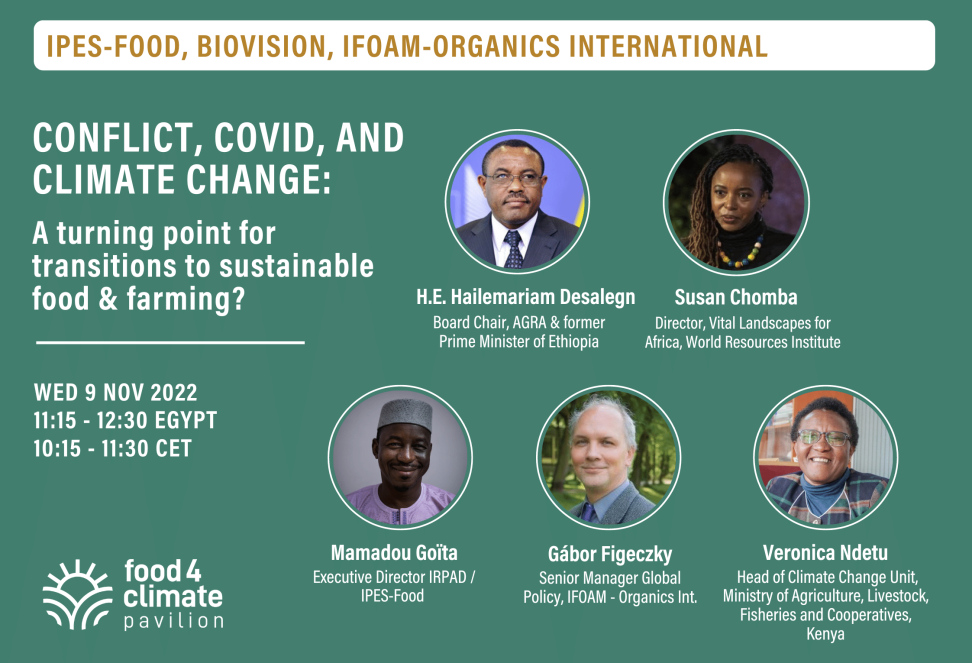
3-Cs-flyer
Conflict, COVID, and climate change: A turning point for transitions to sustainable food & farming?
09.10.2022

Over the past few years, conflict, COVID, and climate change have exposed the vulnerabilities of our food systems in the face of shocks. Many of these fragilities are a direct result of our current dependency on costly chemical inputs, lengthy commodity chains, as well as over-reliance on the import of staple foods. This has contributed to generations living in poverty and millions on the brink of starvation, particularly on the African continent. The livelihoods of small-scale farmers and consumers around the world will be greatly impacted unless we upscale practices that work with nature and deliver on the sustainable development goals, such as agroecological, organic, and regenerative farming. However, in light of heightened food insecurity, there are different perspectives on how we should move forward. Standing at this crossroads, what urgent steps should be taken to transition to sustainable food and farming systems?

CFS_image
Responding to the food price crisis: 3 pioneering examples of building resilience through diversity
11.10.2022
Online &CFS red room

The invasion of Ukraine has sparked a third food price crisis in 15 years. World food prices reached record highs in March 2022 and remain at critical levels, hitting food insecure countries and populations hard. Food systems around the world have proven highly vulnerable to these shocks, through their dependency on costly chemical inputs and highly-specialized commodity production, over-reliance on imports of staple foods, and the ongoing cycles of poverty, climate change and conflict that leave millions of people on the brink of hunger.

Countries around the world are now taking steps to mitigate the crisis and build the resilience that is urgently needed to protect against future shocks – from farmer-managed seed systems to the replacement of chemical inputs with agroecological practices. This side event of the CFS50 dealt with pioneering responses governments are developing and deploying, and how we can ensure coordinated, comprehensive action at the global level. Representatives of the governments of Mali, Mexico & Tanzania participated in the event.

20220704_Banner_700x200px_Dialogue3-1
Beyond the farm: exploring the synergies between the agroecology and conservation communities
29.09.2022

This second dialogue of the Agroecology Series on September 15 connected the conservation and agroecology communities to explore opportunities and limitations of agroecology to address conservation needs beyond the farm. Thus, it looked beyond classical on-farm conservation angles (e.g. conservation of local crop varieties and crop wild relatives). Instead, it discussed the contributions of agroecology to mitigate species decline and ecosystem degradation in the landscape, which are less explicitly recognised within existing narratives of the agroecology or conservation communities. The dialogue identified concrete pathways to increase synergies between the agroecology and conservation communities in food system transformation through policy reform, knowledge creation and investment.

20220704_Banner_700x200px_Dialogue3
Agroecology as a response to agri-input scarcity
15.09.2022

This third dialogue of the Agroecology Series on September 29 will reflected on the current global food crisis and the looming scarcity of agricultural inputs. Record prices in fertilizers, supply chain interruption, increasing dependence on synthetic agricultural inputs and on a handful of suppliers underlined the urgency of food system transformation. As a result, a number of countries committed to reducing their dependence on synthetic inputs. The crisis created opportunities to advance food system transformation through agroecology. The dialogue focused on a better understanding of concrete implementation steps and pathways to increase the resilience of food systems to agricultural inputs scarcity through agroecological approaches, in the areas of policy reform, knowledge creation and investments. 
20220602_Banner_700x200px_Infopool
The Interface between Agroecology and Territorial Approaches for Food System Transformation
23.06.2022

This first event of the Agroecology Dialogue Series by FAO and Biovision Foundation, in support of the Coalition for food systems transformation through Agroecology (Agroecology Coalition), explored the interface between territorial approaches and agroecology, and how this interface contributes to the sustainable transformation of food systems. It analysed the relation between both approaches and the pathways needed for public policies, research initiatives, investment mechanisms, and advocacy to support agroecological transitions at territorial scales.

P2P-NBSAP-online-dialogue
Online Dialogue | Boosting NBSAPs through Agroecology
12.03.2024
Online dialogue

To support countries in their revisions of the NBSAPs, the Biovision Foundation, Global Alliance for the Future of Food and WWF International, supported by the Agroecology Coalition, organised on online dialogue on 12 March 2024 in a Peer-to-Peer format (P2P) between national NBSAP focal points, national focal points for food systems and agroecological policies, and non-state actors from countries with current interest and programmes as well as national policies on agroecology, such as Brazil, Cambodia, Colombia, France, Kenya, Mexico, Switzerland, Tanzania, Uganda and Vietnam.

This activitiy is part of the initiative “Boosting NBSAPs through Agroecology“.

SBSTTA-social-media-1-1024x577
SBSTTA26 side event | Seeding Resilience: Nourishing the Future through Agrobiodiversity & Local Food Systems
15.10.2023
UNON, Room CR-8-CEE (First Floor)

This event took place on 15 October 2023 during SBSTTA25 in Nairobi. It showcased agrobiodiversity and local food systems as effective solutions for climate adaptation, mitigation, and nutrition. Through deforestation and land-use change, energy-use, GhG emissions and inorganic inputs, agriculture is a key contributor to climate change, which in turn threatens food security and nutrition of the growing population.

Agrobiodiversity challenges conventional food systems, by changing how food is produced, what it emits, and how resilient it is to climate shocks. Such food system transformation demands a shift in mindset from production to consumption. During the event, keynote speeches provided evidence to justify the need for this shift, and expert panels discussed concrete solutions and ways to protect and use genetic diversity for climate resilience, mitigation and nutrition.