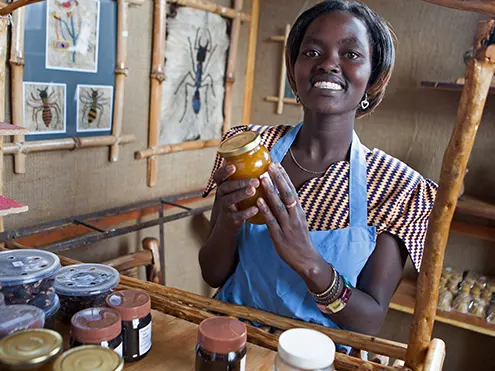
Beekeeping is a sparing use of scarce resources in semi-arid zones. Bee honey is healthy, and its sale brings important income to often destitute families, for example to buy food during extreme dry periods.
Mary Kameun (left) and Nelly Lotoro cook ugali for a party of the Lomut Traditional Dancers. This group also began training in 2004 to become beekeepers and producers of pure bee honey. On the occasion of my visit on December 12, 2006, they celebrated the end of the year with the Kenyan main dish Ugali and Sukuma Wiki. This is a kind of polenta made from very finely ground cornmeal with local feathered cabbage.
“Cabesi was a spark and launched the honey market in West Pokot,” says Mercy Kiyapyap, who was elected co-manager of Cabesi Marketplace after the project handover. And Paul Losute, her husband and co-manager, proudly adds, “Before the project started, the honey from West Pokot was mixed with wax and polluted with bee carcasses. It had practically no value. Today, we produce the best quality honey in Kenya. We are number one in the nation!” Today, a total of about 1600 beekeeping families benefit from this.
Last summer, the West Pokot government designated beekeeping as one of the three main pillars for economic development in the county, along with chicken farming and goat meat production. The Ministry for Lifestock in charge selected Cabesi as the main partner to implement the bee program.
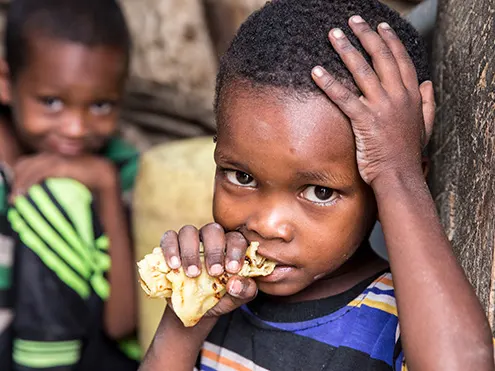
Our picture represents one of the main objectives of Biovision’s work. Because with most of our development projects in Africa, we contribute to the achievement of Goal 2 of the UN Sustainable Development Goals: No Hunger.
Biovision legt in den Projekten in Ostafrika einen Fokus auf die Erreichung von Ziel 2 der nachhaltigen Entwicklungsziele der UNO: kein Hunger.
Die Imkerei ist eine schonungsvolle Nutzung der knappen Ressourcen in semiariden Zonen. Bienenhonig ist gesund, und der Verkauf bringt den oft mittellosen Familien wichtiges Einkommen, etwa zum Kauf von Essen während extremer Trockenzeiten.
Every Biovision project begins with a carefully designed development process. New projects do not emerge by chance, but where there is a concrete challenge within the food system and agroecological approaches have the potential to create lasting change.
Switzerland is making drastic cuts to its international cooperation budget – at a time when global crises are becoming ever more frequent. For Anders Gautschi, CEO of Biovision, this is a strategic mistake. In this interview, he explains why long-term international partnerships are essential for preventing crises and building lasting stability.
Bringing agroecology into the mainstream requires strong partnerships and supportive policy frameworks. 2025 Biovision focused its efforts precisely on these key levers.
The current tensions in the Middle East are drawing attention to oil and energy markets. But the global food system can also come under pressure. Charlotte Pavageau from Biovision explains why this would hit the poorest households the hardest.