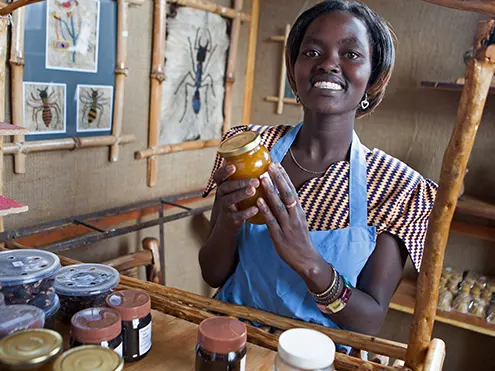
Beekeeping is a sparing use of scarce resources in semi-arid zones. Bee honey is healthy, and its sale brings important income to often destitute families, for example to buy food during extreme dry periods.
Mary Kameun (left) and Nelly Lotoro cook ugali for a party of the Lomut Traditional Dancers. This group also began training in 2004 to become beekeepers and producers of pure bee honey. On the occasion of my visit on December 12, 2006, they celebrated the end of the year with the Kenyan main dish Ugali and Sukuma Wiki. This is a kind of polenta made from very finely ground cornmeal with local feathered cabbage.
“Cabesi was a spark and launched the honey market in West Pokot,” says Mercy Kiyapyap, who was elected co-manager of Cabesi Marketplace after the project handover. And Paul Losute, her husband and co-manager, proudly adds, “Before the project started, the honey from West Pokot was mixed with wax and polluted with bee carcasses. It had practically no value. Today, we produce the best quality honey in Kenya. We are number one in the nation!” Today, a total of about 1600 beekeeping families benefit from this.
Last summer, the West Pokot government designated beekeeping as one of the three main pillars for economic development in the county, along with chicken farming and goat meat production. The Ministry for Lifestock in charge selected Cabesi as the main partner to implement the bee program.
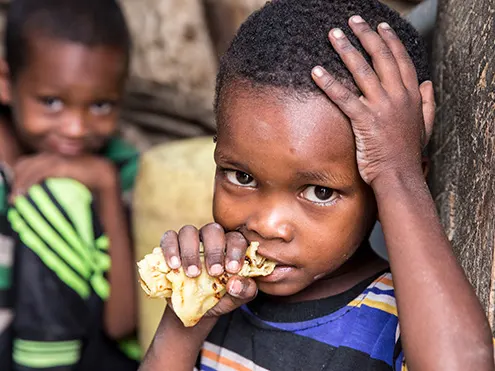
Our picture represents one of the main objectives of Biovision’s work. Because with most of our development projects in Africa, we contribute to the achievement of Goal 2 of the UN Sustainable Development Goals: No Hunger.
Biovision legt in den Projekten in Ostafrika einen Fokus auf die Erreichung von Ziel 2 der nachhaltigen Entwicklungsziele der UNO: kein Hunger.
Die Imkerei ist eine schonungsvolle Nutzung der knappen Ressourcen in semiariden Zonen. Bienenhonig ist gesund, und der Verkauf bringt den oft mittellosen Familien wichtiges Einkommen, etwa zum Kauf von Essen während extremer Trockenzeiten.
Why we need to fundamentally rethink our food system
In his lecture at the Nobel Talks series, Biovision’s Foundation Board President Hans Rudolf Herren explains why agroecology is a key lever for creating a fair and sustainable food system and what actions need to be taken politically and socially.
Biovision is committed to improving the political framework conditions for agroecology. A key lever: the visibility of enterprises that successfully implement agroecology. These enterprises demonstrate that economic success and social commitment can go hand in hand, providing compelling evidence in favour of sustainable agricultural policies. In the video, we use the example of an award ceremony in Kigali, Rwanda, to demonstrate exactly how we shine the spotlight on these enterprises.
Globally, soil quality is deteriorating at an alarming rate—millions of people are affected, and vast areas of agricultural land are being lost. Charlotte Pavageau from Biovision’s Policy & Advocacy team explains why strong political frameworks are essential, what needs to change, and how agroecology is already making an impact.
Accompany our reporter on his journey from his desk to the project area in Ethiopia: See for yourself how reforestation and clever techniques have brought lasting change to this once arid country.