

Ethiopia: Healthy soils, better nutrition and higher incomes
In the Ethiopian districts of Tiyo and Hitosa, we are involved in promoting more sustainable and fairer agriculture on three fronts: We increase farmers’ yields using clever methods, encourage healthier soils and more biodiversity, and also empower women through training and education.
Context: Degraded soils and limited knowledge of agroecology
The soils in Tiyo and Hitosa have suffered severely from deforestation, monocultures, overgrazing, and the impacts of climate change. Due to heavy erosion, rainwater often washes away seeds and cannot properly infiltrate the ground. As a result, many farming families are experiencing major crop losses.
In addition, there is a lack of knowledge about agroecological practices in the region, and the rate of illiteracy – especially among women – is high. This limits their ability to generate a stable income and participate in decision-making processes.
The project pursues three goals:
Improving soil fertility through methods such as tree lines that provide windbreaks and shade, or stone and earth bunds that reduce erosion and allow water to infiltrate the ground.
Increasing yields with sustainable farming: Agroecological practices like mixed cropping, integrating fruit trees or keeping chickens and goats offer families diversified incomes and strengthen resilience to climate risks.
Empowering women and farmers’ groups: Through training in agroecological techniques and management skills, farmers – particularly women – strengthen their autonomy and capacity to make decisions. The goal is for local producers to network, pool resources and develop collective strategies for sustainable production systems.
At a glance
Project name:
Food security in rural Ethiopia
Beneficiaries: Ethiopia
Partner organizations:
ECC-SDCBOM, Caritas Austria – Additional funding: Leopold Bachmann Foundation
Project budget in CHF :
765274
Participants: Smallholder farmers Women
Project Officer:
Project phase: 2024-2026
The project addresses the following SDGs from UN Agenda 2030:
This project is supported by SDC
Region
Topics
Impact to date: Food security is increasing significantly
After the first phase of the project, yields on individual farms increased noticeably. In the Siraro and Arsi Nagelle regions, 70% of the participating families permanently adopted ecological farming methods. By the end of December 2020, food security in the project area had improved by 25%.
Soil fertility, biodiversity and resilience to extreme climate events also increased. Trenches, bunds, reforestation and improved water retention systems proved effective. Farmer networks were crucial: 24 Watershed Management Associations were established, and 6,050 farmers were trained in water management.
Training and networking efforts also strengthened the independence and self-reliance of participating families. The impact was especially visible among women: while it once seemed unimaginable for a woman to lead a farmer group, nearly half of the farmer groups supported by Biovision are now led by women. Women increasingly take part in decisions and contribute directly to agricultural production – gaining reliable incomes in the process.
Next step: Towards a sustainable food system
The project now aims to further improve and expand the sustainable use of natural resources in the region. To reduce pressure on soils and ecosystems, households are supported in generating alternative incomes – for example through beekeeping or poultry farming.
In the long term, local knowledge platforms will be established where farmers can exchange experiences, attend and give trainings, and jointly manage natural resources and farmland. These platforms are intended to promote the co-creation of agroecological production systems and contribute to building a fair and sustainable food system.
More about this or similar projects
About us
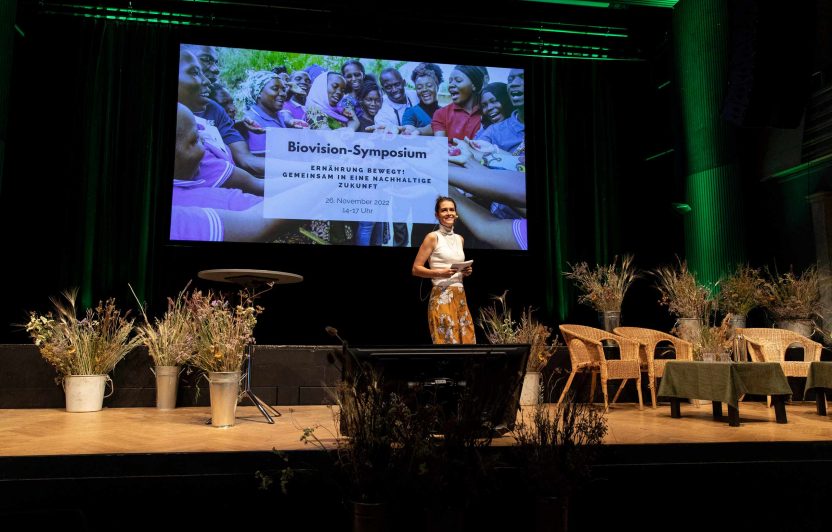
Symposium 2022 review – Food makes a difference!
Together towards a sustainable food system – How do we get there? At the 2022 Biovision Symposium we learned about solutions and challenges for a food system of the future. Here you find impressions from the event and info about “food movements” that strengthen local communities and promote a shift towards organic agriculture.
Agriculture
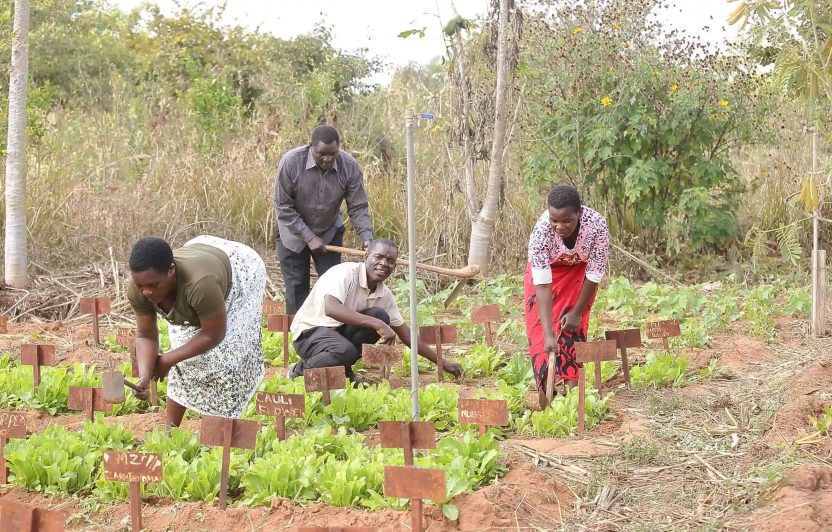
“Engaging women farmers is the key to our success”
For 20 years, Esther Lupafya and Rachel Bezner Kerr have been working together for healthy nutrition in Malawi. In this interview, the founders of Biovision’s partner organisation “Soils, Food and Healthy Communities” (SFHC) talk about gender norms and the power of knowledge exchange and participatory research.
Agriculture
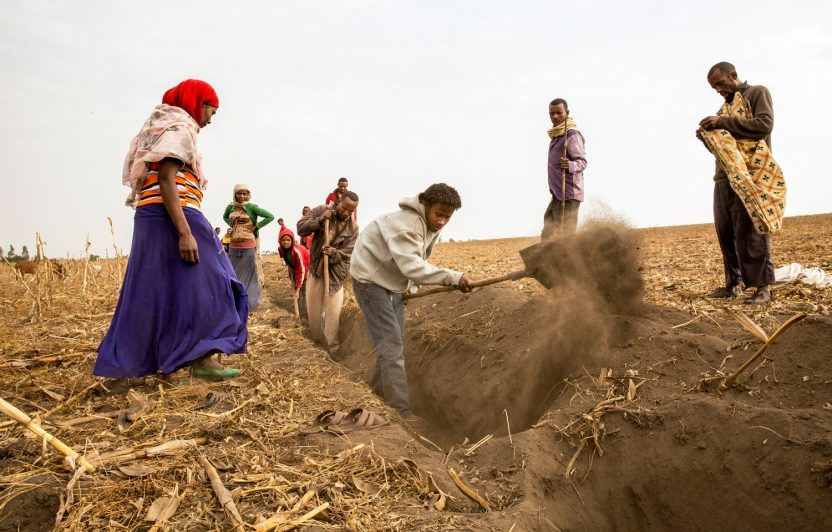
Food security in rural Ethiopia
In southwestern Ethiopia, rural households are struggling with soil degradation and crop failures. Working together, they are taking measures to limit soil erosion and also to diversify their sources of income, in order to protect themselves from crises.