What agroecological enterprises need to create impact
By
Carlo Mariani.
At this year’s World Economic Forum (WEF) in Davos, Biovision convened a panel discussion to explore how agroecological enterprises can succeed and grow. A high‑profile guest even declared himself a fan of agroecology.
At the WEF Climate Hub Davos, Biovision brought together experts from development cooperation, impact investing and philanthropy. The panel discussion took up a central question: How can project-funded agroecological enterprises grow into self-sustaining, viable and investment‑ready business models?
Foundations of agroecology and entrepreneurship
Piera Waibel, Head of International Partnerships at Biovision, opened the session by positioning agroecology as a comprehensive approach: “Agroecology is a science, a practice and a movement that promotes the transformation of our food systems from farm to fork.”
Agroecological enterprises are market‑oriented entities. “They must have commercial activities and embody the principles of agroecology – they are not NGOs or foundations,” Waibel emphasized. Local food systems, food sovereignty and food security are also central considerations. Enterprises relying on monocultures, pure export models or the destruction of local seed systems don’t qualify.
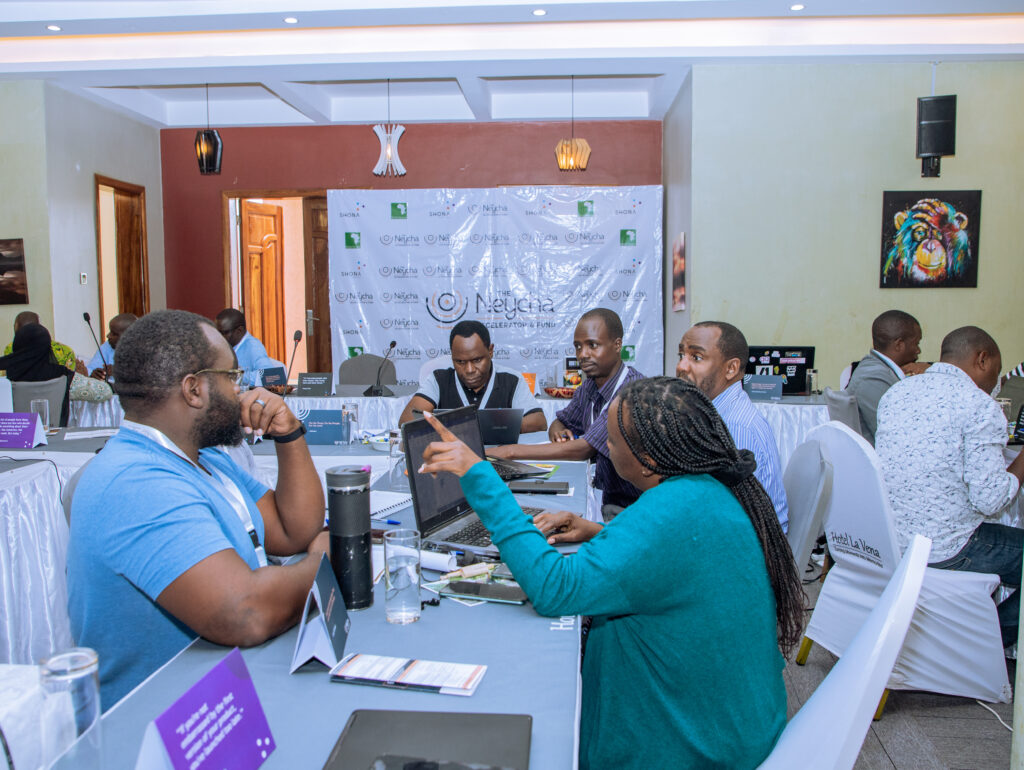
With the Neycha Accelerator & Fund, Biovision has created an integrated, innovative approach: a workshop with agroecology entrepreneurs in Uganda.
From idea to investment readiness
Fabio Leippert, Co‑Head of Policy & Advocacy at Biovision, expanded on why many agroecological enterprises fail to progress beyond early development stages despite
their great potential: “Capital is crucial, but alone is not enough ” he said. Many enterprises are too complex, too slow‑growing or too risky from an investor perspective. At the same time, adequate entrepreneurial support or an enabling political environment is often missing.
With the Neycha Accelerator & Fund, Biovision has created an integrated, innovative approach — a financing instrument that specifically addresses this funding gap in Kenya and Uganda. More than 4 million Swiss francs have been invested to systematically provide capital, entrepreneurial support and networking. The goal is to prepare agroecological enterprises for investment and create access to repayable capital.
Income for farmers
Before the panel discussion began, a video input brought in the practitioner’s perspective. Joachim Ewechu from Shona, a co-implementer of Neycha alongside Biovision, stressed the central role of agroecological enterprises play in systems change: “Agroecological enterprises are the economic engine required for the growth and maintenance of this transformation.” They provide farmers with income, market access and incentives for agroecological production.
“Stable, predictable cash flows and revenues — not just funding — make a company investment‑worthy.” The panel with Stefanie Pondini, Tanja Havemann, Patrick Elmer, Stefan Kappeler and Fabio Leippert (from left).
What is needed for growth?
The panel explored what bridges are required to move agroecological enterprises from dependency on grants to sustainable growth. Tanja Havemann, Co‑Founder and CEO of Clarmondial, made it clear: “Stable, predictable cash flows and revenues – not only grants – make enterprises investable.” Trust, long‑term customer relationships and functioning value chains are essential prerequisites for financing.
Patrick Elmer, founder and CEO of iGravity, shifted the focus to the entrepreneurs themselves: “The most important lever is the mindset of the entrepreneur: the shift from a project‑based approach to an entrepreneurial mindset that focuses on customers who are willing to pay.” Along with capital, patience and high-quality support are needed.
Stefan Kappeler, partner and COO of the Elea Foundation, emphasized that money alone is not enough: “Capital is needed of course, but know‑how is just as crucial.” Many agroecological transitions require time — for instance for soils to recover — and therefore long‑term, “patient” capital is key.
“I am a big fan of agroecology. It is one of the answers for sustainable food systems,” said Christian Frutiger, deputy director of the Swiss Agency for Development and Cooperation (SDC).
Joachim Ewechu summed it up: “When policy, consumption and markets, capital and entrepreneurial engagement are aligned, agroecological enterprises will flourish and agroecology will become the norm.” What matters is not a single tool, but the interplay of capital, policy frameworks, market incentives and entrepreneur support — exactly the interplay strengthened by programs like the Neycha Accelerator & Fund.
Public‑sector perspective and policy framework
Finally, Christian Frutiger, Deputy Director of the Swiss Agency for Development and Cooperation (SDC), added the public‑sector viewpoint. In times of shrinking public funding, international cooperation must be rethought: “International cooperation must act as a catalyst for systemic change.” He also stated clearly: “I am a big fan of agroecology. It is one of the answers for sustainable food systems.”
No silver bullet, but shared responsibility
The panel concluded that there is no one‑size‑fits‑all solution. Scaling of agroecological enterprises requires partnerships, willingness to learn and courage to rethink existing financing and support systems. As Stefanie Pondini, Co‑Head of Policy & Advocacy at Biovision, summarized: “There is no single solution, but there is shared responsibility.”
Every Biovision project begins with a carefully designed development process. New projects do not emerge by chance, but where there is a concrete challenge within the food system and agroecological approaches have the potential to create lasting change.
Switzerland is making drastic cuts to its international cooperation budget – at a time when global crises are becoming ever more frequent. For Anders Gautschi, CEO of Biovision, this is a strategic mistake. In this interview, he explains why long-term international partnerships are essential for preventing crises and building lasting stability.
Biovision is committed to improving the political framework conditions for agroecology. A key lever: the visibility of enterprises that successfully implement agroecology. These enterprises demonstrate that economic success and social commitment can go hand in hand, providing compelling evidence in favour of sustainable agricultural policies. In the video, we use the example of an award ceremony in Kigali, Rwanda, to demonstrate exactly how we shine the spotlight on these enterprises.
Biovision promotes agroecology to leverage a sustainable food system. Entrepreneurs, project leaders and people responsible for initiatives often do not know how much their projects or business model correspond to the 13 principles of agroecology, though. To make their assessments easier (and anchor agroecology more firmly as a result), Biovision has developed the Business Agroecology Criteria Tool, or B-ACT for short.