When hospitals in Italy first sounded the alarm and pictures of hearses queuing outside crematoriums were going viral on social media, the pandemic wave was only just beginning in Africa. The total collapse of health systems, millions of deaths – everyone feared the worst. Terrible news was awaited week after week.
Then, at the end of summer, people rubbed their eyes in amazement: Africa seemed to have been miraculously spared from a major catastrophe – at least in terms of health. The effects of the hard lockdowns that had been enforced were very serious for the many people with low incomes who were unable to carry on working, for small farmers who could no longer sell their products or could only do so to a limited extent.
Spread in areas with herd immunity
But as far as the pandemic situation was concerned, the World Health Organisation (WHO) judged at the end of August that the worst was over on the African continent. There was speculation about the reasons: rapid, tough measures, a young population, better defences thanks to the spread of other coronaviruses and other diseases, the climate.
Now, in February 2021, the worst fears have returned. And unfortunately, they are well founded: the more contagious mutant strain of the virus from South Africa is spreading in more and more countries, especially those where a large proportion of people were already infected, i.e. where herd immunity already prevails to a certain extent. According to the head of the African Union’s disease control organisation, daily case numbers in Africa at the beginning of February had risen to around double the previous peak seen in July and August 2020.
Fears and challenges in project countries
Concern is also high in Biovision’s priority countries Ethiopia, Kenya, Uganda, Tanzania, Malawi, Zimbabwe and Burundi. The situation varies in different countries. The projects will be maintained in all countries, emphasised Andreas Sicks, Head of Development Projects at Biovision. The programme managers are in close contact with the partner organisations – but, according to Andreas Sicks, project visits within the usual framework will probably not be possible again for a few months at the earliest. Partner organisations in Ethiopia, for instance, have reported that it has been possible to continue the programmes without any major obstacles, while in other countries, our project partners face greater challenges due to the restrictions.
The difficulties experienced depend on the governments’ decisions. The project partners have to answer questions such as: are domestic trips still allowed? Can training courses take place on site? Can groups such as women’s groups still meet up? How many people are permitted? Can government agencies attend meetings?
Who will look after the children?
The problems that project staff face on the ground are often not very different from the ones we encounter here, Andreas Sicks points out: “When schools are closed, parents have to work out how to organise childcare, travel restrictions prevent families from coming together, and closed shops and curfews complicate life and work.”
The situation in East Africa’s hospitals is complex. There are reports that they will soon reach capacity, but also that patients can still be admitted. However, the further rise in numbers and the spread of the South African coronavirus variant are definitely a cause for great concern.
Our solidarity is needed
The hope remains that the specific conditions in sub-Saharan Africa which prevented a major catastrophe in the first wave will also help ensure that Africa will be hit less hard by the second, more severe wave than is currently feared. We in Europe can also contribute to this – by making sure that the people of Africa rapidly receive the vaccine doses they need (see the interview with Biovision programme officer Simon Gottwalt) and that there is the necessary capacity for mass vaccination.
Web reports from the Biovision editorial team about the pandemic:
- Malaria and Corona Prevention
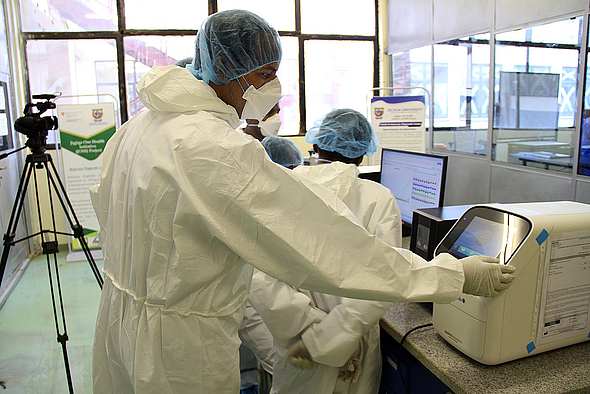
- Project enables coronavirus tests in Ethiopia
- BvAT reacts swiftly with practical information on COVID-19
- The next harvest is even more important now
- This is how easy it is to support organic farms in the lockdown
- What the Corona crisis has to do with the food on our plates
- Corona in Tanzania: Training in hygiene included in organic agriculture courses